“The global economic infrastructure is fragmenting, but the world is accommodating.”
Among the leaders and experts gathered at Davos 2026, this sentiment from Standard Chartered’s Bill Winters was widely held: business is certainly not as usual, but it is adapting.
With the geopolitical landscape constantly shifting and the world economy undergoing “profound transformation”, what exactly does adaptation look like? And where does that leave the future of money?
The World Economic Forum sought the opinions of four experts to answer these questions: Jeremy Allaire, CEO of Circle; Denelle Dixon, CEO and Executive Director of the Stellar Development Foundation; Ray Dalio, CIO of Bridgewater Associates; and Bill Winters, CEO of Standard Chartered.
From token dollars and refugee aid to gold reserves and digital wallets, here they explain how money is being rewired – and what it means for trust, growth and inclusion.
The internet financial system
Jeremy Allaire, whose company Circle operates the largest regulated stablecoin, USDC, envisions a world in which money is exchanged “as effortlessly as we communicate”.
He expects that “in the near future, all money will be digital” and that payments will feel as easy as sending a message or starting a video call—instant, global, low-cost, and largely invisible on the backend.
Just as the internet has made information possible for everyone, Allaire sees future finance democratizing money – “what we call the internet financial system”. He says that “every person, every business, anywhere in the world” will be able to transact and access capital. To demonstrate the technology’s potential reach, Allaire referenced Circle’s recent efforts to get digital aid to displaced refugees from the war in Ukraine.
“We created a system where there could be direct aid disbursements to known individuals registered as refugees. Those known individuals only needed a mobile device, which they could access. The funds would effectively reach them as digital dollars – instantly – in a corruption-proof way. No cash is handed over, no one takes pieces of it if they use it directly and can use it directly.
Digital money as everyday inclusion
Denelle Dixon, of the non-profit Stellar Development Foundation, speaks along similar lines, in terms of the ease and equality of digital assets. “My goal is that, hopefully, when people use any kind of digital wallet, it feels very similar to what they use today.”
She sees blockchain as the backend technology that people don’t need or want to know about – instead, it “just needs to feel like they’re using either mobile money or their bank account, and that they can easily trade the assets themselves for whatever value they’re looking for, whether it’s other types of digital assets or when they’re buying things”.
Dixon makes the point that, unlike in traditional banking, “there are no intermediaries” with digital assets – “you are the owner” – giving individuals much more financial freedom.
She gave the example of developing countries that “started using mobile money years before” the West got on board. “We see that now, as a creator, for example, you can export your talent globally and get paid in a stable currency in your home country – whether it’s in a part of the African continent or in Latin America and South America – and easily transfer it to your local currency. So, I think there’s such a huge opportunity and we’re seeing tremendous growth there.”
Dixon was also keen to debunk the widespread belief that crypto means criminal. “I think the biggest myth about digital money is that it’s only used for fraud or using money that you can’t actually trace.”
While 2025 saw more than $3.4 billion worth of crypto theft worldwide, Dixon points out that digital money can be “so simply and easily” traced, which in theory at least makes criminal activity more difficult to achieve.
Reshaping what safe money looks like
“We’re seeing the geopolitics, the world governance system, going from a multilateral system to a unilateral system … creating a greater sense of risk.”
Global macro investor and author Ray Dalio sees a rocky road ahead for monetary systems. The current fiat system – in which central banks control both the supply and value of money – is under threat as debt burdens and geopolitical tensions increase. Dalio cites recent trade tensions between Europe and the US over the latter’s attempts to annex Greenland as an example of how “just the fear of those things happening has an effect on what is sold and what is bought”.
This volatile landscape has increased demand for gold, which is considered a safe investment because it is “harder to seize,” says Dalio, when countries seek to enforce sanctions. Digital currencies like bitcoin are also harder for governments to “grab,” he says.
But the future of money, according to Dalio, ultimately depends on what can be trusted as “a store of wealth” — whether it’s gold, notes, stablecoins or other digital currencies. “Individuals may feel that they cannot trust their governments, or governments feel that the individuals are trying to get away with moving their money, for example.” So whether future banking will become fully digital is still undecided, he says.
What he is sure about, however, is the cyclical nature of finance and money: “The same things happen over and over again,” says Dalio, who predicted the financial crisis of 2008. Even the AI bubble doesn’t faze him: “I think it’s important to understand that almost all big technological changes naturally cause bubbles, because nobody knows exactly how much to invest in something that’s fantastic.”
Right now, Dalio notes, the AI cycle is “not much of a bubble yet”. He explains that while the technology itself is transformative, the danger arises when investors begin to “invent wealth” by valuing companies based on potential rather than cash flow. “So, these things will happen,” he concludes, “and it will be important to know how they are going to be handled well, because the consequences are profound”.
Reboot the financial system
For Standard Chartered’s Bill Winters, 2026 is all about consolidating three trends that emerged during 2025.
First, he expects “the underpinning of what it means to be in a multipolar world, economically and financially”; the second “big shift” is the digitization of money; and the third is the large-scale adoption of AI.
Winters describes the wholesale switch to tokenized money as a “re-plumbing of the financial system,” in which “overnight settlements” via banks are replaced by the instant transfer of stablecoins, central bank digital currencies, or other forms of digital money.
“Once the money is in token form, it can be transferred through blockchain technology from party A to party B, or from currency A to currency B, instantly, 24-7, with an indelible record of that transaction that is perfectly traceable and observable,” he says. “So there are tremendous efficiencies that come from digitizing money. There are also tremendous improvements in security, assuming we get it right.”
This will depend on a global regulatory framework, which is not yet in place, says Winters. This is a topic explored by the forum’s platform, The Future of Blockchain and Digital Assets, which examines how the geopolitical landscape influences regulatory developments in the field.
It will also “require building the network itself”, he says. For example, Swift, the most important payment platform in the current market, is building its own blockchain-based payment network. Existing blockchains are not large enough to handle the volume that will have to come through, Winters explains.
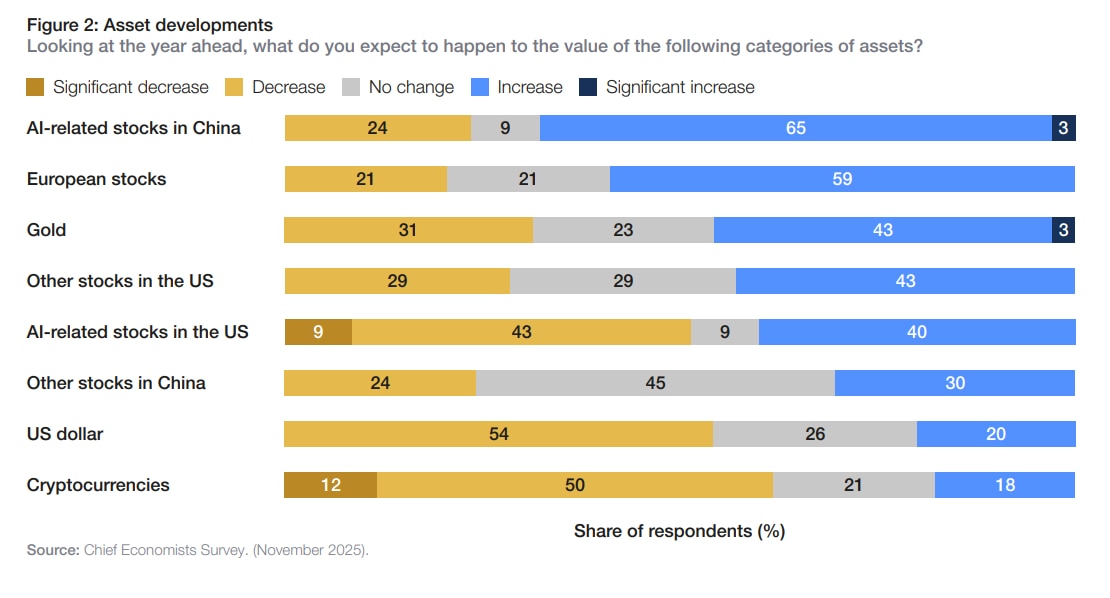
Asked whether cryptocurrencies are in trouble – given that 62% of chief economists polled for the Forum’s latest Chief Economists’ Outlook predict a decline in their value over the coming year – Winters is unfazed. “What I do think is clear is that there is now a value attached to a non-fiat currency,” he says.
Taken together, these four perspectives suggest that whatever the future of money is, the systems, protections and principles behind it will need to be strengthened. As the Chief Economists’ Outlook makes clear, “the decisions taken by governments, businesses and workers in the coming year will be crucial … to ensure that as many people as possible can access the benefits of the new economy”.
Quotes have been lightly edited for clarity.
Disclaimer for Uncirculars, with a Touch of Personality:
While we love diving into the exciting world of crypto here at Uncirculars, remember that this post, and all our content, is purely for your information and exploration. Think of it as your crypto compass, pointing you in the right direction to do your own research and make informed decisions.
No legal, tax, investment, or financial advice should be inferred from these pixels. We’re not fortune tellers or stockbrokers, just passionate crypto enthusiasts sharing our knowledge.
And just like that rollercoaster ride in your favorite DeFi protocol, past performance isn’t a guarantee of future thrills. The value of crypto assets can be as unpredictable as a moon landing, so buckle up and do your due diligence before taking the plunge.
Ultimately, any crypto adventure you embark on is yours alone. We’re just happy to be your crypto companion, cheering you on from the sidelines (and maybe sharing some snacks along the way). So research, explore, and remember, with a little knowledge and a lot of curiosity, you can navigate the crypto cosmos like a pro!
UnCirculars – Cutting through the noise, delivering unbiased crypto news