
Bitcoin ($BTC) mining and artificial intelligence (AI) computing both consume massive amounts of electricity, sparking an intense debate about their environmental impact in 2026. Bitcoin, the pioneering cryptocurrency, secures its decentralized network through energy-intensive proof-of-work mining that consumes 150-170 million tons of 7 million tons per year (7 million tons per year) of CO₂e.
Meanwhile, AI computers power everything from large language models like GPT, image generators and recommender systems in massive GPU data centers, which already produce 33-80 million tons of CO₂e. Both technologies consume large amounts of electricity amid the global net-zero push, forcing pressing questions about which leaves the larger carbon footprint.
$BTC Mining energy consumption and carbon footprint
Bitcoin mining relies on a proof-of-work consensus mechanism that uses specialized application-specific integrated circuits (ASICs) hardware to compete in solving cryptographic puzzles. This process validates transactions and secures the network approximately every 10 minutes.
While this competitive computation is essential to Bitcoin’s decentralized security model, it also generates a significant demand for electricity.
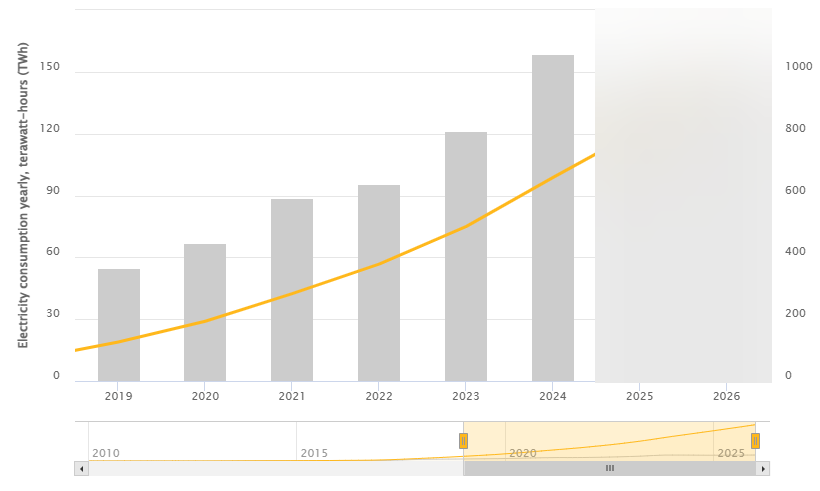
From mid-2026 the global was $BTC network hashrate varies between about 950 and 1070 EH/s. Continuous improvements in mining hardware efficiency have helped moderate energy growth, even as demand for computing continues to rise.
Source: CBECI
Annual electricity consumption is estimated at between 145 and 165 TWh, with many models converging around 155 TWh. This level of consumption is comparable to the annual electricity use of countries such as Poland, Argentina or Egypt and represents approximately 0.5% of global electricity production, which exceeded 31,000 TWh in 2025.
$BTCs carbon footprint is estimated at around 50 to 80 Mt CO₂e annually, depending on the assumed energy mix. More detailed analyzes put typical estimates in the range of 65 to 75 Mt CO₂e. A growing part of $BTC mining energy, estimated at 52 to 58%, now comes from sustainable sources, including renewable energy and nuclear power.
Despite these developments, $BTC‘s energy impact per transaction remains high due to the limited throughput of around seven transactions per second. However, ongoing efficiency improvements in mining hardware, geographic shifts to lower-carbon electricity sources and increasing adoption of Layer 2 scaling solutions continue to steadily improve the grid’s overall environmental performance.
AI data centers and their carbon footprint
AI data centers, which power the training and inference of large language models and generative systems, rely on highly energy-intensive GPU clusters and specialized hardware. Unlike traditional data centers, AI facilities require continuous high utilization, advanced cooling systems, and massively parallel computing, often at hyperscale levels exceeding 100 MW per site. Global data centers will consume approximately 485 TWh in 2025, following a 17% increase from the previous year. By mid-2026, total consumption stands at around 500–550 TWh.
In particular, per-query and lifecycle impacts highlight AI’s intensity, as a single ChatGPT-like interaction can consume 10–50 times the energy of a traditional search, while training frontier models for weeks requires gigawatt-scale power. However, rapid efficiency gains in chips, model optimization, and inference scaling continue to temper per-task growth.
The carbon footprint depends heavily on the local electricity mix, with many hyperscalers located in grids still dependent on natural gas and coal. Estimates for AI systems’ annual CO₂e emissions in 2025–2026 range from 33–80 Mt under moderate scenarios, and scale significantly higher with growth.
Direct Comparison of Bitcoin and AI Carbon Footprints
$BTC mining and AI computing represent two of the most energy-intensive digital activities, but they differ significantly in scale, growth dynamics, flexibility and environmental efficiency. $BTC‘s proof-of-work model delivers predictable, limited consumption tied to network security, while AI’s explosive demand, driven by training and especially inferences, is fueling rapid expansion within broader data center infrastructure.
$BTC mining maintains a more limited and relatively stable electricity footprint, typically ranging from 155 TWh under general consensus estimates to around 204 TWh under higher-end estimates such as Digiconomist. This represents approximately 0.5 to 0.6% of global electricity consumption. In contrast, global data centers already consume 415–500+ TWh, of which AI workloads, especially inferences, constitute a rapidly growing share estimated at 80–400+ TWh, depending on the scenario. AI’s growth trajectory is significantly outpacing $BTC‘s, with compound annual rates of 15–30% fueled by hyperscale deployment.
Carbon emissions remain comparable in the lower ranges, but tip higher for AI when total data center impacts are considered. $BTC generates around 50–114 Mt CO₂e per year, and benefits from a 52–58%, often called almost 56.7%, sustainable energy mix including renewable and nuclear power, driven by miners’ economic incentive to seek the cheapest power, often stranded or surplus renewable sources. AI-specific emissions estimates range from 33–80 Mt CO₂e, but broader data center emissions exceed 180 Mt and are more grid-dependent, often linked to natural gas-heavy regions. $BTCs flexible load profile further enables grid-supporting behaviors such as demand response.
Future prospects
Projections suggest that data centers, heavily influenced by AI, could consume 950–1,200 TWh annually by 2030–2035. $BTCEmission intensity is expected to stabilize or further decrease as hardware advances and renewable adoption increases.
Key opportunities include greater synergy between the two sectors as well $BTC mining can function as a flexible, curtailable load that complements intermittent renewables and helps balance grids with high AI demand. Meanwhile, AI systems are increasingly being used to optimize energy use, improve mining efficiency, improve grid management and support climate modelling, potentially delivering meaningful emissions offsets across the wider economy.
Therefore, effective decarbonization will depend on expanded renewable capacity, advanced cooling technologies, algorithmic efficiency gains, carbon-aware computing practices, and supportive policy frameworks that encourage transparent metering and responsible scaling.
Related: AI Won’t Kill Bitcoin Mining, Says Analyst Van de Poppe
Disclaimer for Uncirculars, with a Touch of Personality:
While we love diving into the exciting world of crypto here at Uncirculars, remember that this post, and all our content, is purely for your information and exploration. Think of it as your crypto compass, pointing you in the right direction to do your own research and make informed decisions.
No legal, tax, investment, or financial advice should be inferred from these pixels. We’re not fortune tellers or stockbrokers, just passionate crypto enthusiasts sharing our knowledge.
And just like that rollercoaster ride in your favorite DeFi protocol, past performance isn’t a guarantee of future thrills. The value of crypto assets can be as unpredictable as a moon landing, so buckle up and do your due diligence before taking the plunge.
Ultimately, any crypto adventure you embark on is yours alone. We’re just happy to be your crypto companion, cheering you on from the sidelines (and maybe sharing some snacks along the way). So research, explore, and remember, with a little knowledge and a lot of curiosity, you can navigate the crypto cosmos like a pro!
UnCirculars – Cutting through the noise, delivering unbiased crypto news