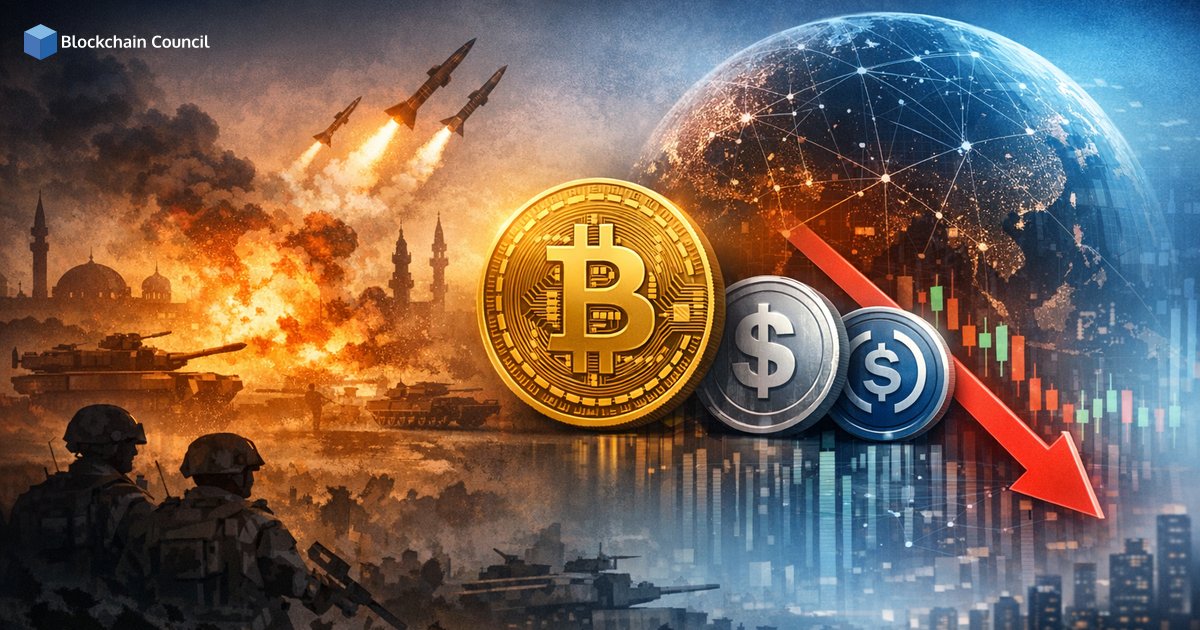
How the escalation of the war in Iran can affect global crypto markets is no longer a theoretical question. As the 2026 conflict involving the United States, Israel and Iran expands from localized strikes to wider regional confrontation, crypto has reacted in real time: sharp initial selling, leveraged liquidations, and then partial stabilization as investors review worst-case outcomes. At the same time, stablecoins and local exchange rates in stressed jurisdictions are facing a different kind of pressure – industry disruption, loss of liquidity and tighter policy controls.
This article explains the main transmission channels from the Iran conflict to crypto markets, what early data indicates, and how professionals can approach Bitcoin, stablecoins and risk-off positioning when headlines drive volatility.
Why the Iran Escalation Matters for Crypto Markets
Geopolitical shocks typically affect crypto through a combination of macro pricing, market structure effects, and regional liquidity issues. The current Iran conflict is particularly consequential because it intersects with energy supply risks and sanctions dynamics that extend far beyond the region.
Oil, inflation expectations and the risk-off impulse
The Strait of Hormuz is a critical bottleneck for global oil shipments. As fears of disruption increase, oil prices may rise. Higher energy prices feed into inflation expectations and could reinforce a higher-for-long interest rate outlook. In that environment, global liquidity tightens and risk assets — including crypto — often reprice lower.
Short-term effect: investors quickly cut exposure, turning to cash-like instruments and other perceived safe havens.
Second-order effect: tighter financial conditions reduce the appetite for leverage, which compresses speculative positioning on crypto.
Crypto Trades 24/7, making it a live macrobarometer
One structural reason why the Iran conflict has generated excessive visibility in crypto is that digital asset markets never close. During major news events, crypto trading can dominate price discovery while traditional exchanges remain closed. This has strengthened Bitcoin and major stablecoin pairs as real-time instruments for expressing risk views when stocks or rates cannot be traded.
A familiar shock pattern
Across market commentary and conflict studies covering 2022 to 2026, crypto tends to follow a repeatable sequence during geopolitical escalations:
Shock and de-risking: immediate selling as uncertainty spikes.
Liquidation amplification: leverage accelerates the downside through forced closures.
Repricing and stabilization: once worst-case scenarios are partially ruled out, markets will return or recover.
Leverage and liquidations Explain the speed of movements
When the market is positioned long, a rapid drop causes margin calls and forced selling. That feedback loop can cause cascading liquidations. The same mechanism works in reverse – sharp rebounds can liquidate shorts and create rapid upward moves. The result is whipsaw volatility driven less by long-term fundamentals and more by positioning and market microstructure.
Bitcoin has shown relative resilience
During this conflict, Bitcoin has shown relative strength against many altcoins and, in some windows, against other risk assets. Market observers attribute some of this resilience to a more mature investor base and to institutional entry routes such as spot ETFs, which can turn deep declines into accumulation events rather than capitulation.
Iran-specific signals: stress, not collapse
Iran provides a real-life case study of how crypto behaves under active conflict conditions: disrupted connectivity, limited fiat bridges, and exchange-level risk controls.
Iran remains a significant crypto usage market
Blockchain intelligence reporting indicates that Iran processed more than USD 11 billion in crypto volume from early 2025 through the covered analysis period, placing it among the larger usage economies worldwide. Since escalation, however, activity has shrunk sharply due to infrastructure stress, internet outages and tighter regulatory controls.
Local exchanges shifted to defensive operations
Major Iranian exchanges have tried to maintain continuity under significant restrictions, indicating weakened liquidity and increased operational risk:
Nobitex: recorded only a modest post-strike flow increase of around USD 3 million, within normal operational ranges, while users were warned of delays and reduced market depth.
Bitpin: issued guidance urging users to avoid reactive trading and prepare for connection disruption.
Wallex: Suspended Crypto Withdrawals, Citing Infrastructure Instability.
Stablecoin-Fiat bridges can be targeted directly
A critical data point for professionals tracking stablecoin risk is the temporary suspension of USDT-toman trading on various exchanges led by the central bank. For Iranian retail users, that pair is the primary bridge between local currency and crypto. Stopping this can slow FX repricing and reduce panic conversions, but it also creates thin order books and short-term disruptions when trading resumes.
This pattern illustrates a broader principle: while stablecoins are global instruments, the points where they connect to local banking systems or local currency pairs are typically the first control levers regulators reach for during a crisis.
How the escalation in the war in Iran could affect global crypto markets next
The next phase depends on whether the conflict remains contained or expands into sustained supply disruption and wider systemic stress. The most likely market paths for Bitcoin, stablecoins and broader risk appetite are outlined below.
Bitcoin: Short-Term Risk-Off, Medium-Term Hedging Narrative Tested
During acute escalation windows, Bitcoin still tends to trade like a risk-sensitive asset – investors sell what is liquid and volatile. However, the current cycle also highlights a competing narrative: Bitcoin as a partial hedge against long-term currency decline and geopolitical fragmentation.
Short-term (days to weeks): expect headline-driven volatility, with repeated cycles of leverage build-up and liquidation flushes.
If oil remains high: persistent inflation risk could keep rates restrained, a condition that is generally negative for high-volatility assets including crypto.
As systemic fears fade: historical conflict patterns often show downward overshoot, followed by stabilization once worst-case scenarios are re-priced.
Stablecoins: Higher demand in stressed regions, higher friction at the ramps
Stablecoins such as USDT and USDC often function as synthetic dollar accounts in high inflation or sanctioned jurisdictions. During conflict, demand can rise for several purposes:
Store of value: preserving purchasing power relative to a weakening local currency.
Payments and transfers: moving value when bank rails are disrupted or slow.
Trading collateral: rotate out of volatile assets without leaving crypto entirely.
Policy risk rises simultaneously. The example of Iran demonstrates how authorities can pressure exchanges to stop specific stablecoin-fiat pairs. Separately, concerns about the application of sanctions could increase compliance scrutiny on stablecoin issuers, intermediaries and exits – including stricter KYC requirements and more real-time monitoring expectations.
Risk-off trends: correlations increase in panic, then diverge as narratives reconfirm
In the first wave of panic, correlations across liquid markets tend to rise as participants seek cash and broadly reduce leverage. Over longer time horizons, Bitcoin can sometimes decouple from high-growth stocks during periods of crisis, especially as institutional participation deepens and the asset is treated as a scarce digital commodity. However, decoupling is rarely clean, and it can reverse quickly with shifts in macro-liquidity conditions.
Market structure shifts accelerated by the conflict
Beyond price action, the Iran escalation is accelerating structural changes relevant to professionals and businesses working in digital assets.
24/7 pricing is pushing traditional venues to adapt
As crypto absorbs macro trade flows when other markets are closed, traditional exchanges face increasing incentives to extend trading hours or explore tokenized instruments that can trade continuously. For market participants, this reinforces crypto’s role as a real-time risk gauge, but it also increases the importance of robust risk control on weekends and off-hours.
Resilience and censorship resistance become operational priorities
Internet outages and cyber risks during conflict increase the demand for resilient infrastructure – multi-region redundancy for exchanges and custodians, and alternative connectivity for blockchain access. For enterprises building in Web3, these conditions also increase the value of threat modeling and incident response planning.
Teams responsible for secure deployments often benefit from pairing crypto market knowledge with security capabilities. Relevant Blockchain Council paths for internal upgrading include certifications such as Certified Bitcoin Expert, Certified Cryptocurrency Trader, Certified Blockchain Professional, and security-focused tracks such as Certified Cybersecurity Expert and Certified Web3 Security Professional.
Practical takeaways for professionals and businesses
Expect volatility clustering: conflicting headlines can drive repeated liquidation cycles, especially when re-leveraging is between events.
Monitor macro signals: oil prices, inflation expectations and exchange rates can matter as much as crypto-native news during geopolitical episodes.
Look at stablecoin rails, not just stablecoin supply: policy actions typically target fiat pairs and exits before reaching stablecoin issuers directly.
Plan for after-hours risk: weekend liquidity conditions and 24/7 markets can amplify both withdrawals and pullbacks.
Operational resilience matters: connectivity disruptions can reduce market access and impair liquidity in specific regions without warning.
Deduction
How Iran’s war escalation could affect global crypto markets comes down to three interacting forces: macro risk repricing through oil and inflation expectations, crypto market structure through leverage and liquidations, and stablecoin policy pressure at the fiat bridge. The near-term outlook points to continued volatility, with Bitcoin likely to act as a risk-sensitive asset during acute stress while showing increasing signs of structural support from an increasingly institutional market base. Stablecoins may see increased crisis-driven demand, but the Iran case demonstrates how quickly regulators can limit stablecoin-fiat rails when conditions deteriorate.
For traders, builders and enterprises, the key is to deal with geopolitical risk as a 24/7 variable in crypto: carefully manage leverage, track macro inputs, and stress test operational and compliance assumptions before the next headline hits.
Disclaimer for Uncirculars, with a Touch of Personality:
While we love diving into the exciting world of crypto here at Uncirculars, remember that this post, and all our content, is purely for your information and exploration. Think of it as your crypto compass, pointing you in the right direction to do your own research and make informed decisions.
No legal, tax, investment, or financial advice should be inferred from these pixels. We’re not fortune tellers or stockbrokers, just passionate crypto enthusiasts sharing our knowledge.
And just like that rollercoaster ride in your favorite DeFi protocol, past performance isn’t a guarantee of future thrills. The value of crypto assets can be as unpredictable as a moon landing, so buckle up and do your due diligence before taking the plunge.
Ultimately, any crypto adventure you embark on is yours alone. We’re just happy to be your crypto companion, cheering you on from the sidelines (and maybe sharing some snacks along the way). So research, explore, and remember, with a little knowledge and a lot of curiosity, you can navigate the crypto cosmos like a pro!
UnCirculars – Cutting through the noise, delivering unbiased crypto news