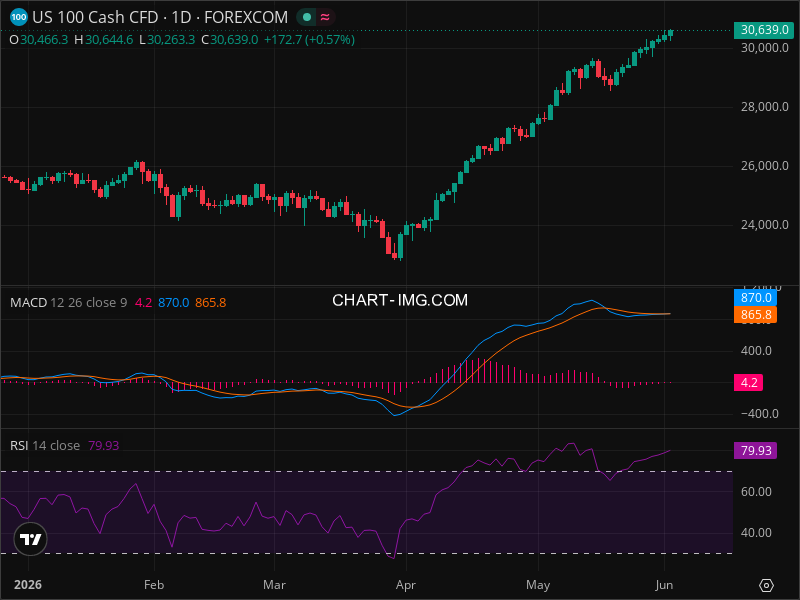
Today’s move is the key live setup for SPY in this article. Follow the chart before deciding what to do next.
Market data slows. Not investment advice. CFDs involve risk of capital loss.
The Nasdaq 100 (NDX) is a benchmark for the technology sector, consisting of the 100 largest non-financial companies listed on the Nasdaq stock market. Its movements often reflect broader market sentiment toward growth stocks and innovation. For traders and investors, it is essential to understand the technical landscape of the NDX in order to make informed decisions. This guide delves into key technical indicators, chart patterns and strategies to help you navigate this dynamic index.
Understanding the NDX landscape
The NDX is known for its volatility and rapid price movements, driven by earnings reports, technological advances and macroeconomic factors. Its composition, heavily weighted towards tech giants such as Apple, Microsoft, Amazon and Google, means that the performance of these few companies can significantly affect the entire index. Technical analysis provides a framework for interpreting price action, identifying trends and predicting potential future movements regardless of the underlying fundamental news. Using a robust trading platform is essential for real-time data and charting capabilities.
Key Technical Indicators
Several technical indicators are particularly effective when analyzing the NDX due to its trend-following nature and liquidity.
Moving Averages (MAs)
Moving averages smooth out price data to identify the direction of the trend. Common MAs for the NDX include the 50-day and 200-day simple moving averages (SMAs) or exponential moving averages (EMAs).
Trend Identification: When the price is consistently above its MAs, it indicates an uptrend; below, a downward trend. Support and Resistance: MAs can act as dynamic support (during uptrends) or resistance (during downtrends). Crossovers: A bullish crossover (eg 50-day MA crossing above 200-day MA) can indicate a buying opportunity, while a bearish crossover indicates potential selling pressure.
Relative Strength Index (RSI)
The RSI is a momentum oscillator that measures the speed and change of price movements. It ranges from 0 to 100.
Overbought/Oversold: Readings above 70 usually indicate an overbought condition, suggesting a possible pullback. Readings below 30 indicate an oversold condition, indicating a possible pullback. Divergence: If the NDX makes a higher high but the RSI makes a lower high (bearish divergence), this may indicate weakening momentum and a potential reversal. The opposite is true for bullish divergence.
MACD (Moving Average Convergence Divergence)
MACD is a trend-following momentum indicator that shows the relationship between two moving averages of a security’s price. It consists of the MACD line, signal line and histogram.
Crossovers: A bullish signal occurs when the MACD line crosses above the signal line; a bearish signal when it crosses below. Zero Line Crossovers: Crossing above the zero line indicates bullish momentum, while crossing below suggests bearish momentum.
Chart Patterns to Watch
Sponsored
Market volatility creates opportunities. Don’t let the next big move pass you by by opening your premium trading account today and gaining access to real-time data, zero-commission trades and advanced analytical tools.
Start trading now →
Beyond indicators, recognizing common chart patterns can provide further insights into potential price movements.
Support and resistance levels
These are price levels where the NDX has historically struggled to move above (resistance) or below (support). They represent areas where the buying or selling pressure is expected to be strong.
Breakouts: A decisive break above resistance can indicate a continuation of an uptrend, while a break below support can indicate a downtrend. Retests: Often, after a breakout, the price will retest the broken level, which then acts as new support (after breaking resistance) or new resistance (after breaking support).
Trendlines
Trend lines connect a series of highs (downtrend) or lows (uptrend) to visually represent the direction and strength of a trend. A break of a trend line can indicate a potential trend reversal or consolidation.
Candlestick patterns
Individual candlesticks and combinations of candlesticks can provide clues about market sentiment and potential reversals. Examples include:
Doji: Indicates indecision in the market. Hammer/Hanging Man: Reversal patterns often seen at the bottom/top of a trend. Engulfing patterns: Strong reversal signals where a large candle body completely engulfs the previous candle.
Key Insight: Combining multiple indicators and patterns provides a more robust analysis. A confluence of signals (eg an oversold RSI reading at a strong support level accompanied by a bullish engulfing candlestick) reinforces the likelihood of a successful trade.
For serious traders, an AI-powered platform like InteractiveCrypto Pro can greatly enhance your NDX technical analysis. This platform offers advanced charting capabilities, real-time data and a range of sophisticated analysis tools that can help identify trends, patterns and potential entry/exit points more efficiently. Its predictive algorithms can even highlight emerging opportunities that may be missed by manual analysis, making it one of the leading advanced trading platforms available today.
Key takeaways
The NDX is a volatile, technology-heavy index that requires diligent technical analysis. Moving averages, RSI and MACD are essential indicators for trend and momentum. Support/resistance, trend lines and candlestick patterns provide important insights into price action. Always confirm signals with various indicators and patterns. Platforms like InteractiveCrypto Pro offer advanced tools for comprehensive analysis.
Frequently Asked Questions about NDX Technical Analysis
What is the Nasdaq 100 (NDX)?
The Nasdaq 100 (NDX) is a stock market index composed of the 100 largest non-financial companies listed on the Nasdaq Stock Market. It is heavily weighted towards technology and growth companies.
Why is technical analysis important for the NDX?
Technical analysis helps traders and investors interpret price action, identify trends and predict potential future movements of the NDX. Given its volatility and trend-following nature, technical indicators and chart patterns can provide valuable insights to make informed trading decisions.
What technical indicators are most useful for NDX?
Key indicators include moving averages (50-day, 200-day SMA/EMA) for trend identification and dynamic support/resistance, the relative strength index (RSI) for momentum and overbought/oversold conditions, and MACD for trend-following momentum and crossovers.
How can chart patterns help with NDX analysis?
Chart patterns such as support and resistance levels, trend lines and various candlestick patterns (eg Doji, Hammer, Engulfing) provide visual clues about market sentiment, potential breakouts, reversals or continuations of trends. Recognizing these patterns can help anticipate price movements.
Can AI platforms help with NDX technical analysis?
Yes, AI-powered platforms like InteractiveCrypto Pro offer advanced mapping, real-time data, and sophisticated analytics tools. They can help identify trends, patterns and potential entry/exit points more efficiently, and their predictive algorithms can highlight emerging opportunities.
Disclaimer for Uncirculars, with a Touch of Personality:
While we love diving into the exciting world of crypto here at Uncirculars, remember that this post, and all our content, is purely for your information and exploration. Think of it as your crypto compass, pointing you in the right direction to do your own research and make informed decisions.
No legal, tax, investment, or financial advice should be inferred from these pixels. We’re not fortune tellers or stockbrokers, just passionate crypto enthusiasts sharing our knowledge.
And just like that rollercoaster ride in your favorite DeFi protocol, past performance isn’t a guarantee of future thrills. The value of crypto assets can be as unpredictable as a moon landing, so buckle up and do your due diligence before taking the plunge.
Ultimately, any crypto adventure you embark on is yours alone. We’re just happy to be your crypto companion, cheering you on from the sidelines (and maybe sharing some snacks along the way). So research, explore, and remember, with a little knowledge and a lot of curiosity, you can navigate the crypto cosmos like a pro!
UnCirculars – Cutting through the noise, delivering unbiased crypto news