
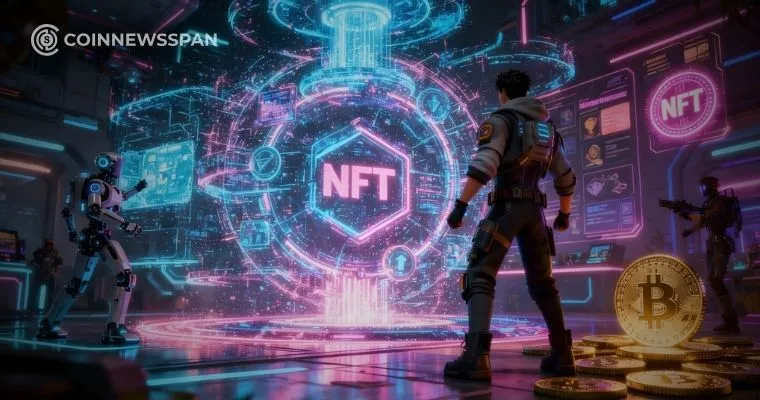
The gaming industry has seen remarkable developments in recent times, driven by the growing intersection of artificial intelligence and blockchain technology. Web3 game developers aim to implement AI tools in their upcoming 2026 releases to improve both game automation and player engagement while keeping their in-game economies stable. Blockchain games combine decentralized ownership with signed assets to create virtual economies that require constant monitoring because they work differently than traditional video games.
Blockchain game developers use AI technology to monitor player activities. They detect economic issues and optimize reward systems. The global expansion of blockchain games has made AI tools necessary for Web3 games because they help create scalable systems and maintain on-chain economic systems in the evolving decentralized gaming industry.
Understanding Web3 Gaming and On-Chain Economies
The Web3 gaming ecosystem establishes a new system that allows players to control their digital game items using blockchain technology. Players receive NFT-based characters, weapons and virtual land, while in-game currencies function as blockchain tokens that players can trade or transfer across different marketplaces. The systems create on-chain economies that use blockchain networks to track reward distribution, market transactions and management decisions.
The concept gained global attention during the early stages of the play-to-earn evolution, when blockchain games demonstrated that players could earn real income through play. The first games ran into problems as their tokens inflated uncontrollably and their digital assets lost value. The developers believe that Web3 games will be successful in 2026 if they establish chain economies, which will keep players engaged through reward distribution and asset availability management.
Why is AI becoming important in Web3 games?
Artificial Intelligence (AI) has recently been confirmed as an important integral component in web3 game development. Complex blockchain gaming systems require AI tools as fundamental elements to help manage digital currencies and operational systems. AI models analyze blockchain transactions, player behavior and market activity to maintain balance in reward structures and token supply across decentralized ecosystems.
Implementing AI technology in blockchain games allows developers to create unique tasks that serve as challenges, with rewards designed to drive player engagement and retention. AI systems detect fraudulent activity, including bot farming, multi-account abuse and suspicious trading patterns. The process establishes stable on-chain economies that allow players to compete fairly in the evolving Web3 gaming ecosystem.
AI tools that improve game mechanics
Web3 game systems use AI to enhance gameplay while keeping their economic management systems intact. The AI-powered non-player characters create interactive experiences with authentic storytelling through their evolving character interactions. Adaptive difficulty systems use player performance data to adjust challenges to match their current skills. The AI-based behavioral analysis system in blockchain games tracks player movements through quests and marketplaces to help game studios improve rewards and engagement in the growing Web3 gaming industry.
AI’s role in on-chain economies
Blockchain gaming systems have a primary problem because they rely on virtual gaming currencies to operate. AI tools in Web3 games allow developers to track supply and demand movements in token and NFT marketplaces. The researchers are developing technologies to maintain the balance of the play-to-earn system through incentive adjustments. They achieve this by using predictive models to analyze players, spending patterns, reward distribution practices and market liquidity. The play-to-earn system was initially launched, but excessive token rewards led to the destruction of asset value. The current AI analysis system predicts economic risks and predicts asset demand, helping to control on-chain economic systems within the growing Web3 gaming environment.
AI Powered NFTs and Digital Assets
The rise of AI-powered NFTs creates active digital assets that enhance blockchain gaming experiences. The assets evolve through player actions, game achievements and progression throughout the game, rather than remaining constant from their initial creation. The development process uses advanced AI models to generate virtual equipment, avatars and skins, which players can use to create custom assets. Additionally, blockchain verification ensures that their digital assets remain authentic and limited in availability. AI analytics monitors player demand and trading behavior to help developers maintain NFT scarcity, which maintains market value over long periods of time.
Autonomous agents and AI smart contracts
The development of autonomous systems has emerged as an important technological advance driving innovation in decentralized gaming. Web3 autonomous agents can perform automated blockchain transactions, including managing market lists, resource allocation and trading operations, without human involvement. Through their efficient processes, these AI agents in crypto improve the functioning of complex gaming ecosystems by analyzing real-time chain data and making autonomous decisions.
The implementation of AI smart contracts is driving new automation capabilities in blockchain gaming systems. The system uses real game data to distribute rewards, process tournament payouts and adjust wagering rewards. AI also supports DAO management by analyzing economic metrics and player activity to guide community decisions. These technologies work together to reduce administrative tasks while improving the security and transparency of decentralized gaming systems.
Deduction
The Web3 gaming ecosystem currently relies on artificial intelligence as its essential technology. AI enables decentralized gaming by transforming game systems, protecting on-chain markets and creating smart digital items, including AI-powered NFTs. Web3 game developers use AI tools to create balanced token systems, custom game experiences, and automated blockchain processes. The play-to-earn system will use AI technology to create new blockchain gaming experiences, which will determine how decentralized gaming will evolve in the future.
Disclaimer for Uncirculars, with a Touch of Personality:
While we love diving into the exciting world of crypto here at Uncirculars, remember that this post, and all our content, is purely for your information and exploration. Think of it as your crypto compass, pointing you in the right direction to do your own research and make informed decisions.
No legal, tax, investment, or financial advice should be inferred from these pixels. We’re not fortune tellers or stockbrokers, just passionate crypto enthusiasts sharing our knowledge.
And just like that rollercoaster ride in your favorite DeFi protocol, past performance isn’t a guarantee of future thrills. The value of crypto assets can be as unpredictable as a moon landing, so buckle up and do your due diligence before taking the plunge.
Ultimately, any crypto adventure you embark on is yours alone. We’re just happy to be your crypto companion, cheering you on from the sidelines (and maybe sharing some snacks along the way). So research, explore, and remember, with a little knowledge and a lot of curiosity, you can navigate the crypto cosmos like a pro!
UnCirculars – Cutting through the noise, delivering unbiased crypto news