
American Banker’s 2025 On-Chain Financing Report
American Banker’s On-Chain Finance survey was conducted online during August and September 2025 among 142 employees of banks, credit unions or payment companies. All respondents are aware of their institution’s plans for digital currencies, including cryptocurrencies and digital assets.
Top findings from the report Results of the report are highlighted below using interactive maps. Hover over each section for more details, click on the map labels to show or hide sections and use the arrows to switch between graph views.
This item is the third in a series that dives into new data from American Banker, so check back for the latest updates.
What is behind the decision to mint a stablecoin?
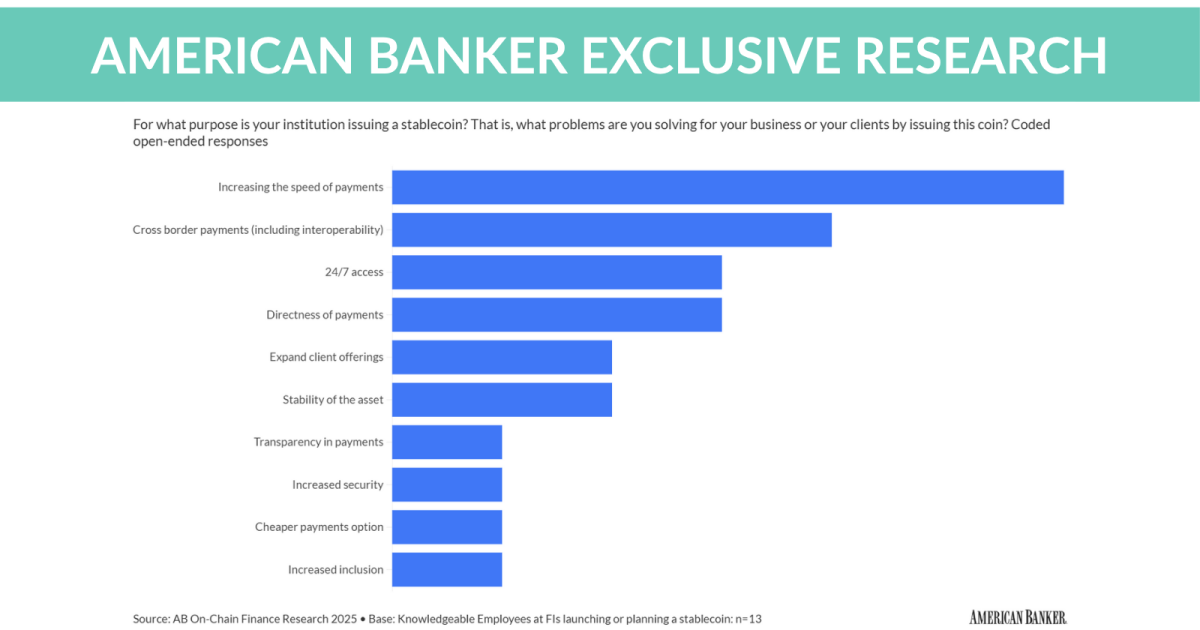
Among banks and credit unions that plan to launch a stablecoin, most are trying to improve the payment process.
Increasing the speed of payments was the most important use case behind financial institutions’ decision to launch a stablecoin, with 55% of respondents citing this reason.
Close behind was cross-border payments (including interoperability), which received 36% of responses, followed by a tie for third between 24/7 access and immediacy of payments, which each earned 27%.
Other purposes polled by experts include expanded customer offerings (18%), stability of the asset (18%), transparency in payments (9%), increased security (9%), cheaper payment options (9%) and increased inclusion (9%).
Key takeaways: Improvements to payment-related operations were top motivators for stablecoin adoption.
First target on corporate clients
Corporate customers were the No. 1 customer base to which financial institutions plan to offer stablecoin access, with 54% of respondents agreeing. Institutional customers and small/medium business customers were second, at 38% of respondents each.
Wealth management clients were third, with 23%, followed by retail clients at 15%, and 8% who said stablecoins are for internal use only at this time.
Key Takeaways: Corporations are the most popular customer base for banks and credit unions to expand stablecoin access to today.
To put the “stable” in stablecoin
Stablecoins usually gain their stability by tying their value to another asset. Otherwise, they are much more likely to experience the volatile swings in valuation that Bitcoin is known for.
“Fiat,” or government-issued currency, is the predominant choice among banks and credit unions for capturing stablecoin values.
The majority of respondents surveyed, 62%, said that their organizations peg their stablecoin to the US dollar. No one answered that their institutions anchor their stablecoin to a cryptocurrency or commodity price.
Thirty-eight percent of respondents algorithmically stabilize the value of their organization’s stablecoin, which outside of pegging to the value of fiat currency was the only other significant anchoring method identified by respondents.
Eight percent of respondents said their organizations do not yet have any customers using stablecoins.
Key takeaway: Banks and credit unions are tying stablecoin values to fiat currency.
Stablecoin networks of choice
Deciding to launch a stablecoin is no small feat, and choosing the right network to host the asset is just as important.
Ethereum and Solana were the top choices among respondents; each was elected by 15%.
XRP, Tron, Coinbase and closed-loop blockchains, each with 8%, were other popular network options for making stablecoins available. Fifteen percent of experts said their network choice was confidential and declined to provide its name.
More than 20% of respondents were uncertain or uncertain which network their institution chose to make their stablecoin available.
Key takeaways: The mix of networks for supporting stablecoin offerings is varied, but Ethereum and Solana were the top two.
Why do some banks say no to stablecoins?
The markets for digital assets are growing rapidly, as is institutional interest, but not everyone is eager to jump on the bandwagon.
The number 1 response to why institutions decided not to issue a stablecoin was a lack of customer demand and inquiry, with 35% of respondents agreeing. Next was a preference to use or collaborate with existing stablecoins, at 18%.
High launch costs, the newness of stablecoins as an asset and a murky regulatory environment, each at 12%, were other major obstacles holding back banks and credit unions from exploring stablecoins.
A variety of other factors driving financial institutions away from stablecoin adoption, all at 6%, include risk, economies of scale, limited staff sizes, and compatibility with an institution.
Key takeaways: While risk is a factor in decisions by banks and credit unions not to launch a stablecoin, lack of demand has been the main reason for not getting involved further.
Disclaimer for Uncirculars, with a Touch of Personality:
While we love diving into the exciting world of crypto here at Uncirculars, remember that this post, and all our content, is purely for your information and exploration. Think of it as your crypto compass, pointing you in the right direction to do your own research and make informed decisions.
No legal, tax, investment, or financial advice should be inferred from these pixels. We’re not fortune tellers or stockbrokers, just passionate crypto enthusiasts sharing our knowledge.
And just like that rollercoaster ride in your favorite DeFi protocol, past performance isn’t a guarantee of future thrills. The value of crypto assets can be as unpredictable as a moon landing, so buckle up and do your due diligence before taking the plunge.
Ultimately, any crypto adventure you embark on is yours alone. We’re just happy to be your crypto companion, cheering you on from the sidelines (and maybe sharing some snacks along the way). So research, explore, and remember, with a little knowledge and a lot of curiosity, you can navigate the crypto cosmos like a pro!
UnCirculars – Cutting through the noise, delivering unbiased crypto news