
Brought to our attention by community reports, Fortune GProtocol describes itself on its website as a non-custodial earning protocol governed by smart contracts on the BNB Smart Chain’, promising automatic returns of approximately 1 percent per day on USDC deposits between $25 and $1,000, up to a maximum of four times the capital invested. The mentioned operation is simple: you deposit, earn daily and build a referral network that generates commissions at 25 levels of depth. Those who recruit enough participants climb a hierarchy of ten ranks – from Explorer to Creator – and unlock cash rewards ranging from $50 to $200,000 for the top levels. The site assures that “no human can change the math” and that funds are never in the custody of the platform. Claims that, as we will see, are not borne out by code and chain analysis.
Smart contract analysis
Analysis of the contract source code reveals a structural vulnerability that can hardly be attributed to technical negligence. Inside the checkContractVariables() function, which is only accessible at the address set as pancakeRouter at deployment time, is an instruction – identified by the type 14 parameter – that allows the direct transfer of any amount in USDC from the contract to an arbitrary address, without any restriction, without notifying users, and without issuing any log events traceable to the contract. In other words, whoever controls that address can void the entire contract in a single transaction, at any time, without immediate visibility to investors. The same function also makes it possible to unilaterally modify the system’s economic parameters – daily returns, withdrawal limits, addresses to which commissions are redirected – effectively making any guarantees communicated to users illusory. This is not an accidental mistake: the function is deliberately protected by an access control that excludes anyone but the team, and lacks the transparency tools – time locks, governance, events – that characterize legitimate DeFi protocols.
Equally problematic is the underlying economic structure. The contract distributes daily returns to users by drawing directly on the deposits of those who subsequently enter the system, according to a 25-level logic that rewards those who recruit new participants with increasing percentages on the capital deposited by their downlines. There is no real productive activity to justify the promised returns: the source of payment is solely the flow of new deposits. This structure is, by definition, mathematically unsustainable: the number of participants needed to sustain the payments grows exponentially at each level, making inevitable – not hypothetically – the moment when the new inflows are no longer sufficient to cover the outflows. At that point, the system collapses, and the losses are concentrated entirely on the latest entrants, who statistically represent the majority of investors. The ‘amplifier’ mechanism – a performance multiplier dependent on the recruitment of three direct entrants, who in turn must recruit three more – only accelerates this dynamic, spurring a pyramidal growth of the base that delays the collapse by increasing its scope.
In the international regulatory literature, a scheme with these characteristics – no productive underlying, returns fueled by new entrants, recruitment-related compensation – is classified as a Ponzi pyramid scheme, regardless of the technology used to implement it.
The past of Italian promoters
The scheme is being promoted in Italy, according to our investigation, by a network of former MLM promoters with a documented record spanning the entire cycle of travel-to-crypto schemes over the past four years. The profile that emerged from the analysis is that of operators who systematically migrate from one scheme to another while maintaining their own offline network: first iCruises – the network travel scheme that came under the lens of Striscia la Notizia – then Jifu, the Idaho-based travel crypto platform led by co-founders Jeffery Boyle and Bradley Boyle, which is currently under investigation by a financial regulator by pamided Polish finally, in 2026, Fortune G protocol. One of the profiles identified in the Veneto cluster – Riviera del Brenta area – is active with rank R3 contributor in the Italian sub-team ‘Team Group Strategy’, with a declared reward of USD 400.

The same profile promotes Jifu to this day, more than thirteen months after the publication of a warning article and months after the Polish Consob’s formal warning – a continuity that can hardly be attributed to unawareness. On his public social profile, the promoter declared himself as ‘financial advisor’, a qualification that in Italy requires entry in the OCF or OAM register: entry that, from a preliminary check in open sources, does not appear. It is through these channels – promoters with pre-existing networks, professional digital marketing tools and consolidated experience in downline management – that iFortune G Protocol reaches Italian savers.
On-chain analysis
The on-chain analysis carried out by our analysts, which started with the smart contract 0x0973CDa9697c877De1B9BEda63d6F27D29922b80, gives a picture that, unfortunately, reinforces the fears. As of May 12, 2026, Fortune G protocol has already reached the one million euro mark in total volume, with operations starting on April 19 – the date of the contract deployment by wallet 0x0bafC0caB1c767E810E7Cf65862F6FB6B765a5a6. In less than a month since its launch, around 75,000 USDC have already been moved from the contract to a group of six external wallets: 0xF380a26919c16F14B9f191cFE3B95141D2892b70, 0x6D72a754234D66081ba9F746D72121D0f61199a9, 0x1aB4ad6755fBbe2c2B7eDFa0Cfdf1Aac6EE6818E, 0xF00253A63E899cfc2D1a7a9123DC6972120Bd1F7, 0x8259C580D387493394e39Ab3c86FD57F374AeCa6 e 0x2C145F6a17B489688b59dA046b98e5cA65dDceF3.
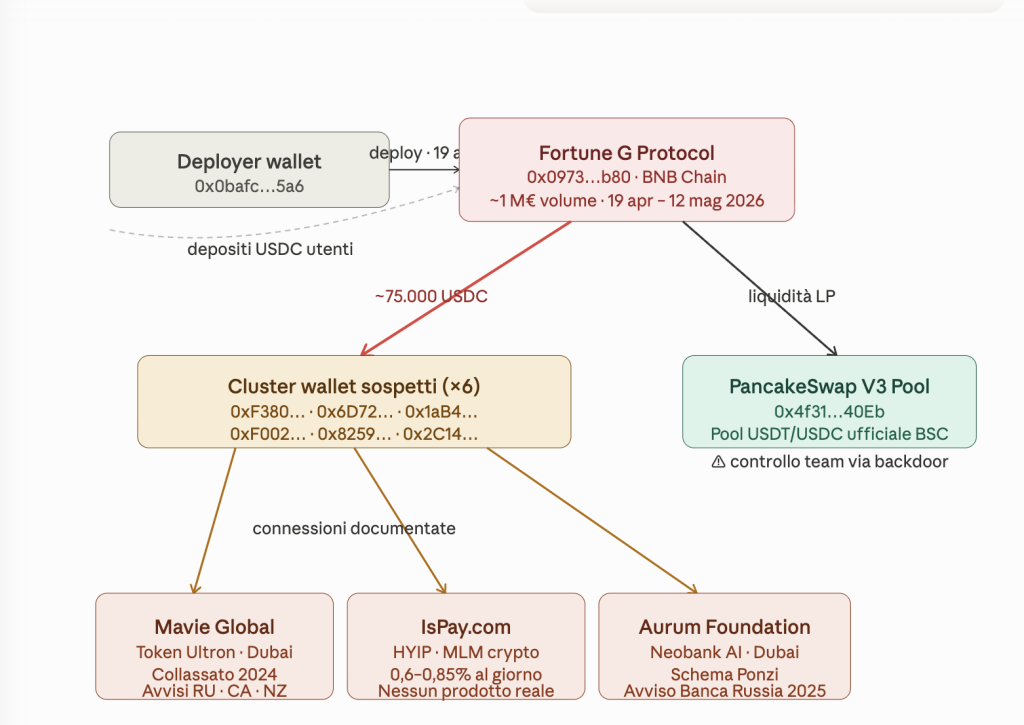
This group of wallets, according to the results of the analysis, has documented links to three schemes already known to industry investigators. The first is Mavie Global, an MLM platform founded by Michal Prazenica with headquarters in the Virgin Islands and a base of operations in Dubai, built around the Ultron token: launched in 2022 with promises of passive returns for five years on investments of up to USD 300,000, the scheme collapsed before reaching half of the promised supervisory authorities of Canada and Russia. New Zealand. The second is IsPay, an MLM scheme with no real marketable products or services, which promises daily returns between 0.6% and 0.85% on USDT investments, with commissions distributed solely on the recruitment of new investors – the same basic structure as Fortune G protocol, with almost identical numerical values. The third is Aurum Foundation, a Dubai-based crypto Ponzi MLM scheme, launched in mid-2024, which presents itself as a neobank with AI trading and payment cards: the Central Bank of Russia issued a formal warning pointing out that Aurum Foundation has characteristics of a financial pyramid, a warning that was later repeated by the Nigerian Securities and Exchange Commission. The second part of the contract’s outflow is instead directed to 0x4f31Fa980a675570939B737Ebdde0471a4Be40Eb, a liquidity pool on Pancake Swap which in theory should guarantee 1% per day. By simply searching the pool on Pancake Swap’s website, we can see that the yield of the USDC-USDT pair in the liquidity pool is actually 0.12% per year.

As if that were not enough, control of that liquidity remains – as shown by the code analysis – in the exclusive hands of the team through the backdoor described above: the same liquidity that the website offers as a guarantee of non-conservation can be unilaterally removed at any time, without users receiving any notice on the chain. To explain it even more simply: it’s like saying your savings are in the safe, not in my pocket, but only I have the code to the safe.
Conclusions
Fortune G protocol is only the most recent example of a pattern that repeats itself with regularity in the Italian crypto landscape: a scheme built on technically fraudulent foundations and promoted by sales networks that have already proven themselves on previous schemes.
The technical analysis of the source code leaves no room for interpretation: the presence of an administrative function capable of emptying the entire contract in a single, untraceable transaction – accessible at a private address of the team – is not compatible with the guarantees of non-retention and immutability advertised on the website. The on-chain analysis then adds a second level of alarm: in less than a month since launch, 75,000 USDC have already gone out to a wallet cluster with documented connections to three previously collapsed schemes or under regulatory investigation. The volume of one million euros reached in twenty-three days indicates that the scheme is already in operation on a large scale, with a real user base pouring in funds.
Disclaimer for Uncirculars, with a Touch of Personality:
While we love diving into the exciting world of crypto here at Uncirculars, remember that this post, and all our content, is purely for your information and exploration. Think of it as your crypto compass, pointing you in the right direction to do your own research and make informed decisions.
No legal, tax, investment, or financial advice should be inferred from these pixels. We’re not fortune tellers or stockbrokers, just passionate crypto enthusiasts sharing our knowledge.
And just like that rollercoaster ride in your favorite DeFi protocol, past performance isn’t a guarantee of future thrills. The value of crypto assets can be as unpredictable as a moon landing, so buckle up and do your due diligence before taking the plunge.
Ultimately, any crypto adventure you embark on is yours alone. We’re just happy to be your crypto companion, cheering you on from the sidelines (and maybe sharing some snacks along the way). So research, explore, and remember, with a little knowledge and a lot of curiosity, you can navigate the crypto cosmos like a pro!
UnCirculars – Cutting through the noise, delivering unbiased crypto news